
Nashville Warrant Checks
Nashville publishes no public warrant search, roster, recall form, or dedicated warrant line. So start with the paper itself. Keep the full citation, the hearing notice, the date, the issuing agency, and any Indiana cause number. With those details in hand, town staff and the Brown County Clerk can tell a simple local violation payment apart from a court-file event.
- For a Nashville ordinance, parking, or town traffic citation, call Town Hall at 812-988-5526 or Nashville Police at 812-988-0341.
- Ask which current venue holds the matter and whether a missed date was forwarded to Brown Circuit Court.
- Search MyCase by name, citation, or cause number and narrow the court to Brown Circuit Court, code 07C01.
- Confirm the eligible court chronology with the Brown County Clerk at 812-988-5510.
- Ask the Brown County Sheriff at 812-988-6655 for safe service or surrender routing, and contact counsel before appearing if arrest is possible.
A payment balance, an old Town Court reference, and a MyCase search each answer a different question. Read together in Nashville, they still cannot confirm present warrant status on their own.
Nashville Has No Warrant Portal
The official Nashville Police Department page lists a department address, phone routing, a Town Marshal reference, and links to ordinance and payment material. It offers no public warrant database or roster. The page itself stays contact-first.
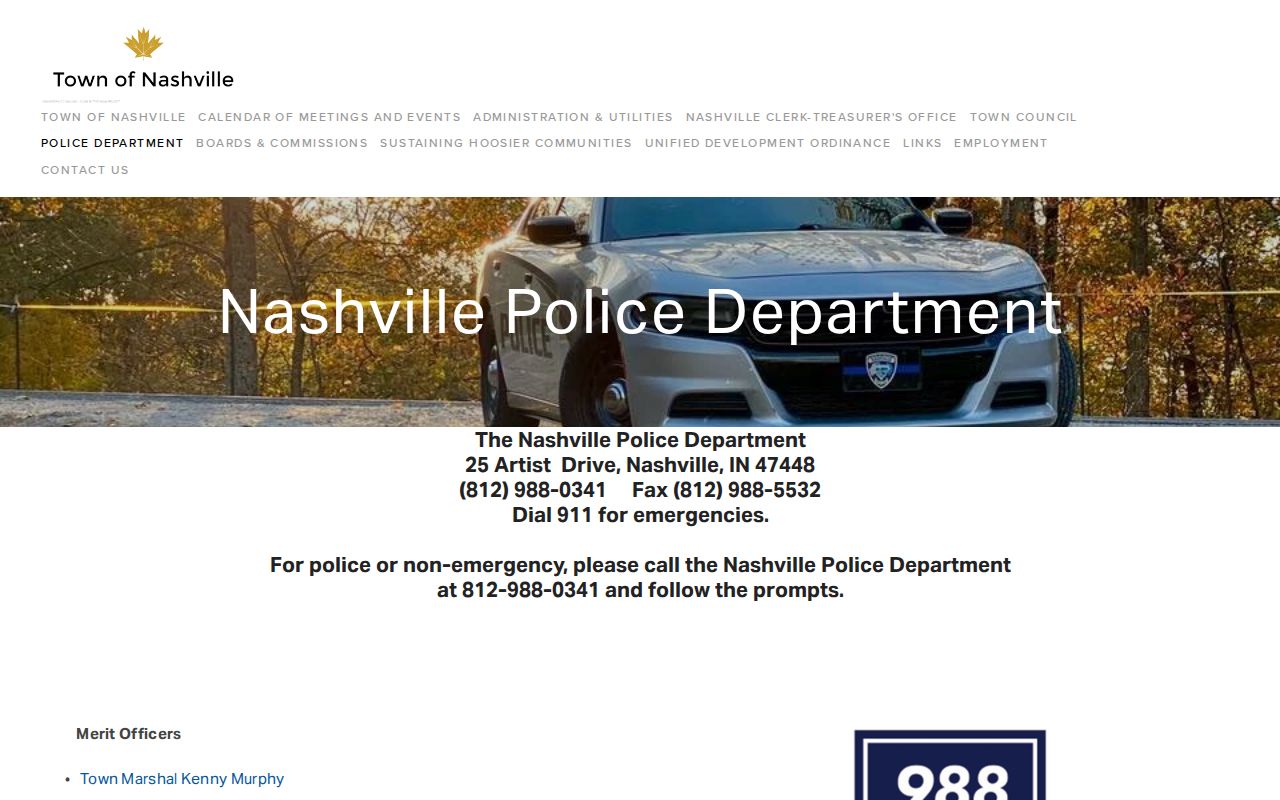
That official page points callers to phone routing rather than a warrant lookup. Say up front that the question concerns your own citation or a relative's matter. Then ask which office can confirm the current file, since police staff do not serve as court clerks.
Policing and Courts in Nashville
Nashville Police works from 25 Artist Drive, Nashville, Indiana 47448. The department lists 812-988-0341, fax 812-988-5532, and 911 for emergencies. For non-emergencies, the official material says to call the department number and follow the prompts, though no warrant-specific hours or line exist.
Nashville Town Hall
200 Andy Rogers Way, P.O. Box 446, Nashville, IN 47448. Phone 812-988-5526; fax 812-988-5527; townhall@townofnashville.org. Published weekday hours are 8 a.m. to 4 p.m. Town Hall routes ordinance and town-payment questions.
Brown Circuit Court and Clerk
The currently listed trial court and Clerk are at 20 E Main Street. Court: 812-988-7557. Clerk: 812-988-5510. Published weekday hours are 8 a.m. to 4 p.m. The Clerk confirms eligible public court-file information.
Nashville's historical code describes a Town Court, but the current Indiana court directory lists no separate Nashville court. That gap is worth a phone call. Town staff can explain current ordinance administration, and the Brown Clerk can say whether a case entered Circuit Court.
Nashville Warrant Venue History
Nashville's venue history explains a lot of confusing paperwork. Title III of the town's administration code created a Town Court and called it a court of record. The town also posts a 2017 traffic-court ordinance, a 2018 ordinance-violations-bureau measure, diversion material, and a 2024 Town Marshal ordinance. Those records explain why older papers use court terms. They do not show a currently operating separate court or warrant docket.
Venue answer: Ask Nashville Town Hall where the ordinance matter sits today, then ask Brown Clerk whether it has a Circuit Court cause.
Careful wording prevents a false claim here. Nashville keeps a local enforcement and payment lane. But the town offers no independent municipal warrant database, warrant counter, or public recall calendar.
Warrants in Nashville: The Main Types
A Nashville resident may hear several warrant terms, and the issuing authority always depends on the file. Brown Circuit Court is the confirmed trial court. Town ordinance and citation materials form a first-contact lane, not a separate warrant court.
| Warrant or matter | How it may arise | First verification route |
|---|---|---|
| Bench warrant | A missed required court appearance or failure to comply with a court order | Brown Clerk and Brown Circuit Court |
| Arrest warrant | A criminal charge supported by the required judicial finding | Brown Clerk, court, and Sheriff |
| Traffic or ordinance matter | A Nashville citation, unpaid violation, or missed local date | Nashville Town Hall or Police, then Brown Clerk if filed |
| Search warrant record | A judicial authorization to search, subject to access restrictions | Holding court or agency when public |
In Indiana, "bench warrant" and "warrant for arrest after failure to appear" work as the practical terms here. Nashville sources use no local "capias" label.
Missed Nashville Dates and Warrant Risk
A missed Nashville date deserves a prompt check. It does not justify assuming a warrant. Keep the citation and its envelope, note the scheduled date, and call the town contact printed on the paper. Ask whether the matter still sits in the ordinance-violations process, whether a new date is available, and whether it was filed elsewhere.
- Call Town Hall or Nashville Police with the citation number and date.
- Ask for the present venue and the exact next procedural step.
- If given a Brown cause number, review the public MyCase chronology and call the Clerk.
- Ask counsel about any failure-to-appear or warrant event before going to an office.
- Keep the written order, receipt, or new hearing notice after resolution.
Nashville runs no warrant amnesty day, safe-surrender event, automatic recall policy, or missed-date reset form. Staff instructions and any judge-approved order control the outcome.
Nashville Warrant Records: What They Show
A matched public record works best as a set of linked fields. The cause number ties together the person, court, case type, and events. An entry noting a missed hearing may explain a timeline. Only the latest order shows whether a Nashville warrant was issued or later recalled.
| Cause or citation number | A town citation reference or Indiana case identifier, possibly tied to 07C01. |
|---|---|
| Name and identifiers | Enough data to distinguish records; public views may redact protected information. |
| Case type | IF, OV, CM, or another code that identifies the proceeding, not warrant status by itself. |
| Issuing authority | The judge and court connected to the order, if public. |
| Chronology | Hearings, filings, failure-to-appear events, warrant orders, recalls, and dispositions when accessible. |
| Bond or payment | Amounts and conditions that must be confirmed with the court, Clerk, or Sheriff. |
| Access limit | Sealed, juvenile, expunged, investigative, or protected content may not appear. |
Nashville's Ordinance Payment Lane
The town payment page walks users through selecting Indiana, Town of Nashville, and Town of Nashville–Violation. It also allows payment in person at the Town Clerk-Treasurer or by mail to Town Hall. The listed fees are one dollar online and three dollars by phone. Confirm those details before paying, since vendor terms shift. The reason is concrete. Brown County's payment page says the county moved from PayGov.US to BridgePayment on January 18, 2024, and no longer accepts PayGov.US. Nashville's page still references PayGov for town violations. County and town systems do not swap, and a Nashville payment page is not a warrant-status check.
Before paying: Confirm the jurisdiction, current vendor, amount, and whether payment alone changes any hearing or warrant order.
Nashville Warrants and Brown County
Nashville is the Brown County seat, which concentrates the town, Circuit Court, Clerk, Sheriff, Jail, and Court Services contacts in one place. A town citation starts with Nashville. A Brown-filed criminal, infraction, or ordinance case belongs to Brown Circuit Court. The Sheriff is the local service and surrender contact. Indiana has no single public statewide arrest-warrant database, and MyCase is a case-search fallback rather than a warrant register. The full county route is summarized in Brown County warrant records.
Warrant flow: Nashville Police or town ordinance process › Brown Circuit Court and Clerk when filed › Brown County Sheriff for service
Nashville's Three Justice Addresses
Three different counters answer three different questions in Nashville, and mixing them up wastes a trip. Town Hall, at 200 Andy Rogers Way, is the place for town administration and ordinance routing. Police calls belong to Nashville Police at 25 Artist Drive. Warrants are a court matter, so Brown Circuit Court and its Clerk sit at 20 E Main Street, while the Sheriff and Jail operate from 55 State Road 46 E. One caution: older town payment instructions may still point to 200 Commercial Street. That was the address before a street renaming, and current Nashville material uses 200 Andy Rogers Way. Call Town Hall before you mail a payment or records request. Nashville also publishes no special warrant-visit security, accessibility, or interpreter directions, so anyone needing an accommodation should ask by phone first. A quick call saves travel and keeps sensitive facts away from the wrong counter.
Accessing Nashville Warrant Records
Indiana law leans toward open records, but with real limits. Town administrative and police records follow the Indiana Access to Public Records Act. Court records answer to the Indiana Rules on Access to Court Records instead. A request only reaches what the office itself keeps. It cannot force Nashville to build a warrant list that does not exist.
Key Rules:
Indiana Access to Public Records Act, IC 5-14-3 gives access to existing public agency records subject to statutory exceptions.
Indiana Rule on Access to Court Records 4 generally makes court records accessible unless another rule excludes them.
Indiana Rule on Access to Court Records 5 limits sealed, juvenile, investigative, search-warrant, probation, expunged, and protected personal material.
Gaps are not proof. MyCase may skip documents, or whole categories, that sit only at the Clerk's office. An investigatory-record exception can also block a law-enforcement request, and neither silence rules out a Nashville warrant.
Nashville Warrant Resolution Proof
Once you know which venue holds the matter, ask exactly what ends it. A town violation may need payment. It may need a new appearance or another local step. A Brown Circuit Court warrant is heavier: counsel, a motion to recall or quash, service, surrender, bond, or an appearance the judge approves. The Brown Clerk takes authorized payments but cannot recall a warrant on its own. Brown's local bond rule adds a wrinkle, since bond on an arrest warrant is not accepted until the warrant has been served. Do not assume a town payment satisfies that rule, or that a county bond schedule covers a Nashville ordinance balance. Whatever step you complete, keep the receipt and the order. Then confirm the docket or holding agency shows the warrant as recalled, served, or otherwise resolved. Nashville's size does not soften that proof requirement. Its 2020 population was 1,256, and it is the only verified incorporated town in Brown County. The justice offices crowd into one spot, yet each keeps a distinct role. Residents out in the forest-heavy county often call or drive into Nashville for these services. Call before you go. A town ordinance question, a Clerk record check, and a Sheriff service question each land on different staff and different records.